News · Product Design & Engineering · AI Reliability & Operations
ClawDOS puts an AI coding harness on an IBM PC XT
The DOS client manages the conversation and tools, a separate machine handles TLS, and the hosted Claude API runs the model.
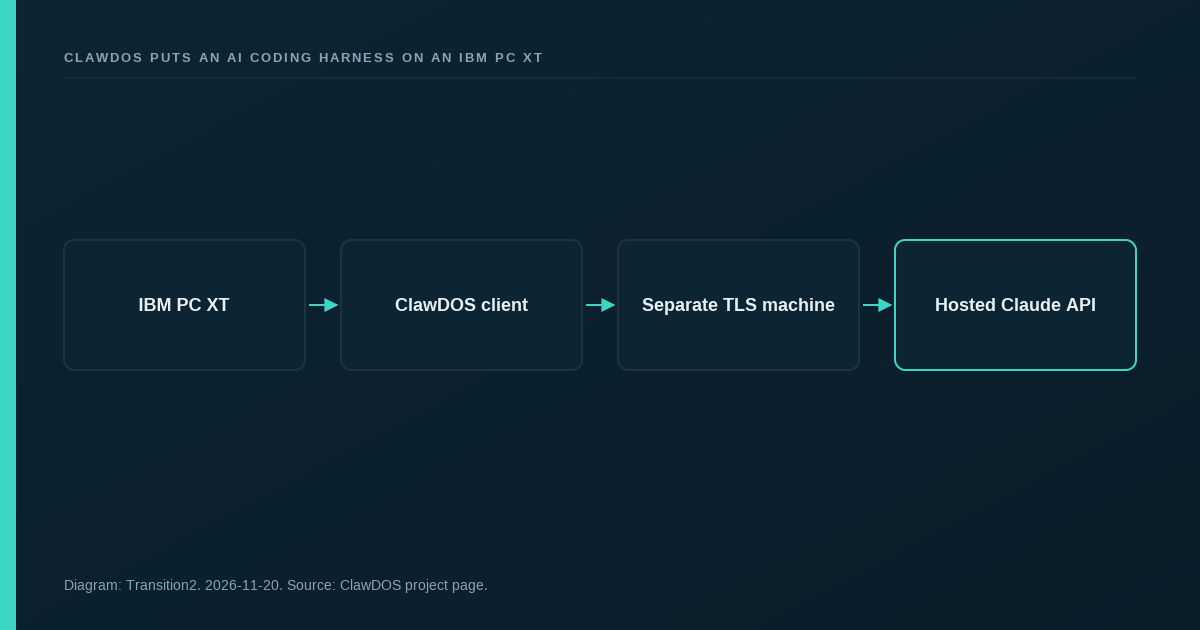
ClawDOS is an open-source AI coding harness documented to run on an IBM PC XT with an 8088 processor. The DOS program builds requests, handles streamed responses, executes tools and keeps conversation history. A separate machine handles TLS, and the hosted Claude Messages API performs model inference. ClawDOS project page
What happened
Ricapar documents the demonstration on the project page and publishes the DOS harness in the source repository. The harness handles the conversation and tool interactions on the retrocomputer. It constructs the requests sent through the API connection, consumes the responses as a stream and keeps the history needed for subsequent turns. This is the software running on the PC XT in the demonstration. ClawDOS project page | ClawDOS source repository
The documented setup gives another machine responsibility for TLS on behalf of the DOS client. Requests travel to the hosted Claude Messages API, where the model runs. The recurring interaction therefore involves client code on the PC XT, connection handling on another machine and model execution through the hosted service. The project page is undated. ClawDOS project page
The repository also includes a local mock of the Messages API that emits scripted streaming responses for offline tests. Those scripted responses give a test a defined sequence to work with. The mock and the hosted service serve separate purposes in the project, with one providing a controlled fixture and the other supplying the model responses used in the connected demonstration. ClawDOS source repository | Offline Messages API mock
Why it matters
The engineering demonstration shows how much of an AI interaction can be handled by a client even when the model runs elsewhere. The 8088 executes the harness responsibilities documented by Ricapar. TLS processing and inference take place beyond the machine, making the boundaries among the three components central to understanding what the project demonstrates. The machine named in the headline is the host of the client. ClawDOS project page | ClawDOS source repository
The streaming design gives those boundaries a concrete consequence. What arrives through the transport has to be interpreted as application events, and the client needs to identify when the response has completed. A scripted mock supplies a way to focus on the event sequence. The desk tried to examine a related transport and application boundary using an independent fixture, with the results below. Offline Messages API mock
What the Transition2 desk tested
The desk ran an in-memory simulation instead of the proposed loopback connection. The specified pin was CPython 3.12.8, with only the standard library. The simulation fed a chunked HTTP response to Python's HTTP decoder. It put HEL and LO in separate text deltas and split the first delta's JSON across HTTP chunks. The complete fixture was meant to reconstruct HELLO and observe a single message_stop. The negative fixture omitted message_stop and was meant to produce an incomplete-response result.
CHECK json_crosses_http_chunks: PASS first delta text is split after H
CHECK reconstruct_text: FAIL observed deltas None
CHECK single_message_stop: FAIL observed status error, stop count None
CHECK negative_missing_message_stop: FAIL observed status error, stop count None
CHECKS 1/4
Both fixtures returned AttributeError because the in-memory BytesIO object lacked peek. The layout check established that the JSON crossed a chunk boundary. Reconstruction and both application completion checks failed to produce the intended observations.
What this does not show. The error came from the desk's fixture. The run did not exercise Ricapar's mock or DOS client, the PC XT, the TLS machine or the hosted API. It provides no result about how ClawDOS handles a response split across chunks or one that ends without a completion event.
What it means for businesses
The demonstration offers a clear example of why an inventory of AI components should identify where each responsibility lives. An interface on one machine can handle conversation and tools while depending on separate transport and model services. In a review informed by AI Reliability & Operations, evidence about one of those responsibilities can be assigned to the component that actually performs it. Ricapar's documentation makes those assignments visible in this setup. ClawDOS project page | ClawDOS source repository
What it means for AI users
From the user's side, the conversation can take place in the DOS program even though the model response comes from the hosted API. The documented project gives the DOS client responsibility for history and tools and gives the other components responsibility for the connection and inference. That division explains which part of the interaction is being shown when the PC XT displays a streamed response. ClawDOS project page | ClawDOS source repository
The repository's offline mode uses a scripted response fixture. A screen showing that stream can demonstrate a client interaction with a mock. A connected session is the evidence for an interaction with the hosted model. The source repository documents the components needed to distinguish those two settings. ClawDOS source repository | Offline Messages API mock
What it means for developers
The project provides separate places to verify client behavior and connected behavior. Scripted events from the offline mock give a defined input for client tests. The connected setup adds the separate TLS machine and the hosted API. A report about streaming can specify which of those components participated, what events the client received and how it decided the response was complete. An application-level completion result depends on observing the relevant event handling, as the desk's failed fixture illustrates. ClawDOS source repository | Offline Messages API mock
Copyright Eric MacDougall.
Sources
- ClawDOS project page (accessed 2026-11-21)
- ClawDOS source repository (accessed 2026-11-21)
- ClawDOS offline Messages API mock (accessed 2026-11-21)