News · Enterprise AI Governance · Evaluation, Measurement & ROI · Models, Tooling & Developer Practice
OpenAI embeds four outside safety assessors, keeps redaction rights
Apollo Research, METR, Transluce and Goodfire get scoped access to training runs and may publish, while OpenAI may redact confidential information.
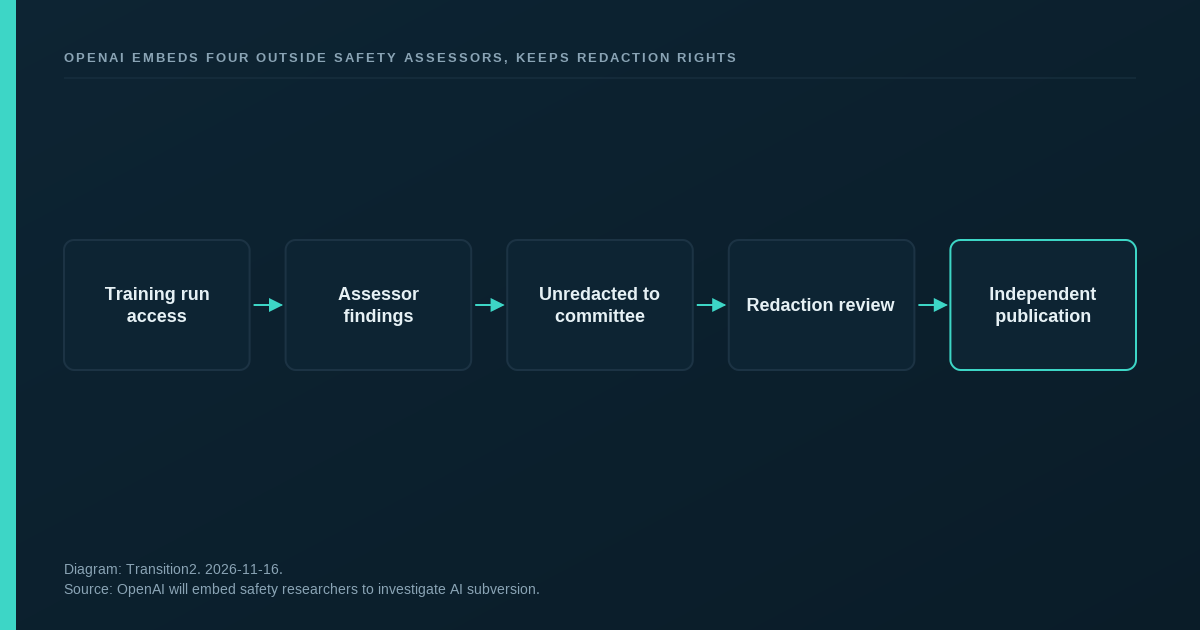
OpenAI announced first-phase embedded assessment agreements with Apollo Research, METR, Transluce and Goodfire on November 16, 2026, giving outside researchers scoped access to training runs, checkpoints and monitoring records (TechCrunch). The assessors may publish independently, but OpenAI may redact confidential information. Critics, including Apollo itself, say the access falls short of what full independence requires.
What happened
OpenAI's own announcement page could not be loaded by the desk, so the terms below follow the readings of TechCrunch, Unite.AI and Tech Times.
Each assessor has a different remit. Apollo Research assesses whether models could covertly work against developers' intentions or subvert alignment and control mechanisms, and whether OpenAI's safeguards would catch that (TechCrunch). METR's first assessment covers OpenAI's largest reinforcement-learning run to date, with access to checkpoints, rollouts and misalignment-monitoring records; a second, broader monitor assessment is waiting on agreement about scope (Tech Times). Transluce examines the quality and coverage of OpenAI's post-training alignment evaluations, and Goodfire embeds interpretability researchers to analyze model internals and support training-run monitoring (Unite.AI).
Apollo gets access to training data and code, checkpoints, and evaluation and monitoring records, limited to agreed claims, models and time periods (TechCrunch). Its pilot has six evaluators, according to AI Weekly as reported by Tech Times.
The funding arrangements differ. Apollo and Goodfire are paid, and payment does not depend on results; METR and Transluce take no payment but may accept compute or API credits (Unite.AI).
On publication, assessors may publish independently, OpenAI may redact confidential information, and unredacted reports go to OpenAI's Safety and Security Committee (TechCrunch). Tech Times identifies Zico Kolter as the committee's chair. OpenAI may withhold information for technical, security or intellectual-property reasons, but not simply because it is unfavorable (TechCrunch).
OpenAI and Transluce intend a follow-on assessment of about eight weeks in early 2027, which Unite.AI and Tech Times describe as an intention rather than a commitment.
Not everyone sees the terms as sufficient. Redwood Research CEO Buck Shlegeris says the agreements fall short of "employee-like access," and Apollo says true independence requires "employee-level access," according to TechCrunch.
The sources also disagree on several points. TechCrunch says Apollo's pilot began the week of publication. Tech Times says TechCrunch reported that Apollo gave no start date, which contradicts TechCrunch's own account; a four-month duration mentioned in newsletter digests could not be confirmed in a primary source. For Transluce, Tech Times also cites a separate account of a six-week pilot starting in early December, and TechCrunch says Transluce tests release-readiness use in 2027. Unite.AI says OpenAI may request responsible-disclosure delays before publication, while Tech Times notes that only one summary reports that term.
Why it matters
The substance of the announcement is in the access and disclosure terms. Outside reviewers will see material usually kept internal, including checkpoints, rollouts and monitoring records from OpenAI's largest reinforcement-learning run (Tech Times). That access is scoped to agreed claims, models and time periods, and OpenAI keeps the right to redact and to withhold for technical, security or intellectual-property reasons (TechCrunch).
The rule that information cannot be withheld just because it is unfavorable is the main safeguard against selective disclosure, and the routing of unredacted reports to the Safety and Security Committee keeps a full record inside the company. Whether that adds up to independent review is exactly what critics dispute: both Redwood Research's CEO and Apollo describe a gap between these terms and employee-level access (TechCrunch).
Payment that does not depend on results, and unpaid arrangements for METR and Transluce, address one obvious conflict of interest (Unite.AI).
The Transition2 desk did not run an experiment for this story because it is a governance agreement with no public code, schema or reproducible artifact.
What it means for businesses
Companies that rely on OpenAI models now have a named set of outside assessors whose published findings may inform vendor risk reviews. The caveat is that published reports can be redacted, and the full versions go to an internal committee (TechCrunch). Procurement and risk teams reading future reports should note what scope each assessor had and what was withheld, using the terms reported here. The structure also offers a reference point for how third-party model assurance can be contracted, a theme covered under Enterprise Governance and Evaluation & ROI.
What it means for AI users
For people using OpenAI products, the agreements add outside scrutiny of whether models could work against their developers' intentions and whether safeguards would catch it, which is Apollo's remit (TechCrunch). No findings have been published yet in the sources, and there is no confirmed timeline for when they will be. Users should read any eventual report alongside its stated scope and redactions rather than as a general clearance.
What it means for developers
For teams building evaluation practice, the four remits map to distinct methods: behavioral testing for covert subversion, review of a live training run's monitoring, auditing the coverage of post-training evaluations, and interpretability work on model internals (Unite.AI). METR's access to checkpoints, rollouts and misalignment-monitoring records (Tech Times) shows the kind of artifacts that make external review of training possible, which is relevant for anyone designing internal monitoring that may later need outside audit. More on evaluation methods is collected under Models & Practices.
Copyright Eric MacDougall.
Sources
- OpenAI will embed safety researchers to investigate AI subversion (accessed 2026-11-17)
- OpenAI Signs Four Independent Assessors for Embedded Safety Reviews (accessed 2026-11-17)
- OpenAI Embedded Assessments Let Evaluator METR Probe Largest Training Run; Findings Can Be Redacted (accessed 2026-11-17)