News · AI Reliability & Operations · Enterprise AI Governance · Evaluation, Measurement & ROI
SOC alert triage study tests RL and anomaly detection under limits
On nearly 75,000 analyst-labeled alerts, an arXiv paper reports that three triage methods met a benign-escalation limit and flagged largely different alerts.
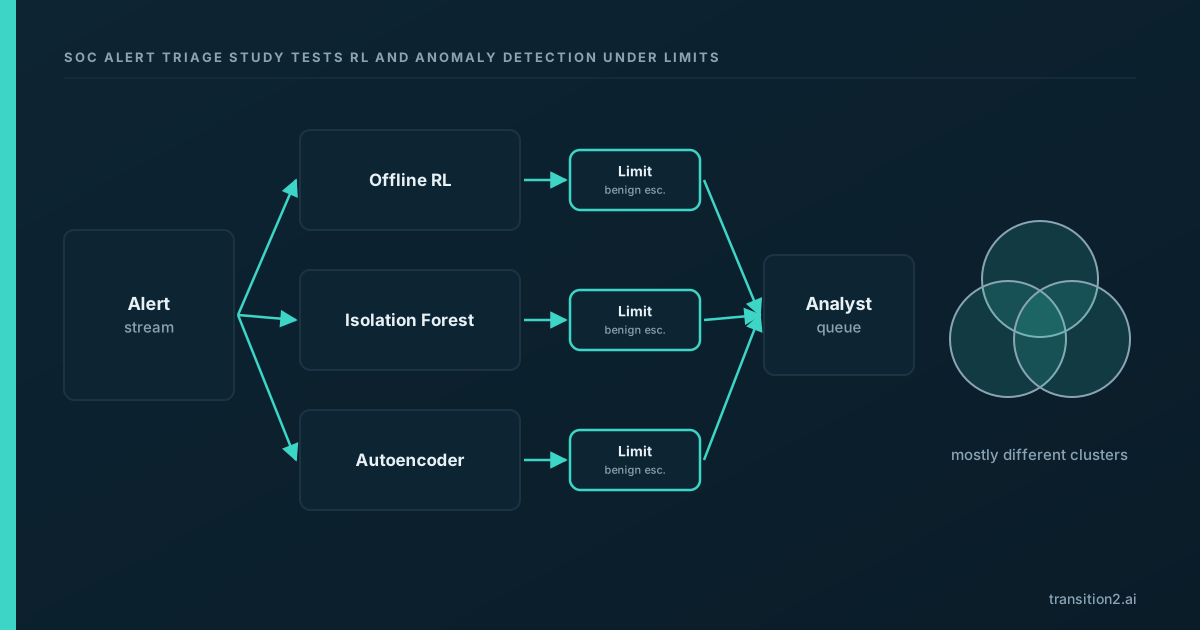
Evaluating security alert triage as a decision made under limited analyst capacity, rather than as plain classification, changes what a good model looks like, according to a paper by Radityo Ghifiardi and Rifny Rachman first posted to arXiv on November 3, 2026. On 74,909 analyst-labeled production alerts, the authors report that three quite different methods all met a strict limit on benign escalations, and that they tended to escalate different groups of alerts. The findings come from the authors' own evaluation and have not been independently replicated.
What the paper reports
The abstract starts from a practical problem in security operations centers (SOCs): analysts have limited time, so escalating harmless alerts can delay investigation of serious ones. The authors argue that framing triage as classification or anomaly detection is incomplete for production SOCs. The real task, in their framing, is choosing which alerts are worth escalating when capacity is limited, when missing a real threat and raising a false alarm are not equally harmful, and when workload limits apply.
They formalize triage as a constrained decision problem and compare three approaches:
- an offline reinforcement learning (RL) policy trained on alert embeddings, which learns actions from reward;
- an Isolation Forest model built on operational features, which isolates unusual operational patterns;
- an autoencoder trained on historical benign alerts, which detects departures from normal benign behavior.
All three were evaluated on 74,909 analyst-labeled production alerts, using a strict temporal split (training on earlier alerts and testing on later ones) and a constraint on benign escalations. Because the test set contains only 503 unique feature patterns, the authors mainly rank clusters of similar alerts rather than individual alerts.
At the main operating point, the authors report that all three methods satisfy the constraint. On the paper's benign-escalation fraction, a measure of how much harmless activity gets escalated where lower is better, the RL policy scored lowest at 0.000, compared with 0.007 for the autoencoder and 0.041 for Isolation Forest. They also report that the methods prioritize largely different alert clusters, which they describe as complementary rather than redundant coverage. Their conclusion is that production SOC triage can benefit from constraint-aware evaluation and from combining or adapting between model families.
The abstract does not state how many real threats each method escalated, how many organisations the alerts came from, or how results change at other operating points. The small number of unique feature patterns in the test set may also limit how finely the methods can be told apart.
Why it matters
Alert triage looks like an easy target for automation, and it is also a place where a strong score can mislead. A model judged on balanced accuracy says little about what happens when it may only escalate a handful of alerts per shift. Building the operating limit into the evaluation, as this paper does, measures the decision the system will actually be allowed to make.
The complementary coverage result is just as useful. If different model families surface different alert clusters, choosing a single winner on one headline metric can quietly drop coverage. The AI Reliability & Operations hub covers tying autonomy to evidence of this kind.
What it means for businesses
Do not let an AI system close or suppress alerts on its own until it has been evaluated against the team's real limits: analyst review capacity, an acceptable rate of benign escalations, and response time targets. Ask vendors to report results at a stated operating point and on a time-ordered test set, not only as an overall accuracy figure. Keep decisions about widening autonomy with an accountable owner.
What it means for AI users
For analysts working beside a triage model, the essentials are the ability to override and the evidence behind each suggestion. A proposed escalation should show the signals that drove it. Overrides should be easy and recorded, since they show where a model falls short. If several models are in use, knowing which one raised an alert helps explain why it surfaced.
What it means for developers
Evaluate triage methods with a temporal split and at the operating point the system will run at, and report the benign-escalation fraction alongside how many real threats were escalated. Check how many unique feature patterns the test set really contains, because heavy duplication can make results look more precise than they are. Compare what each candidate model escalates, not just its score, before choosing one. The paper is the reference for its method.